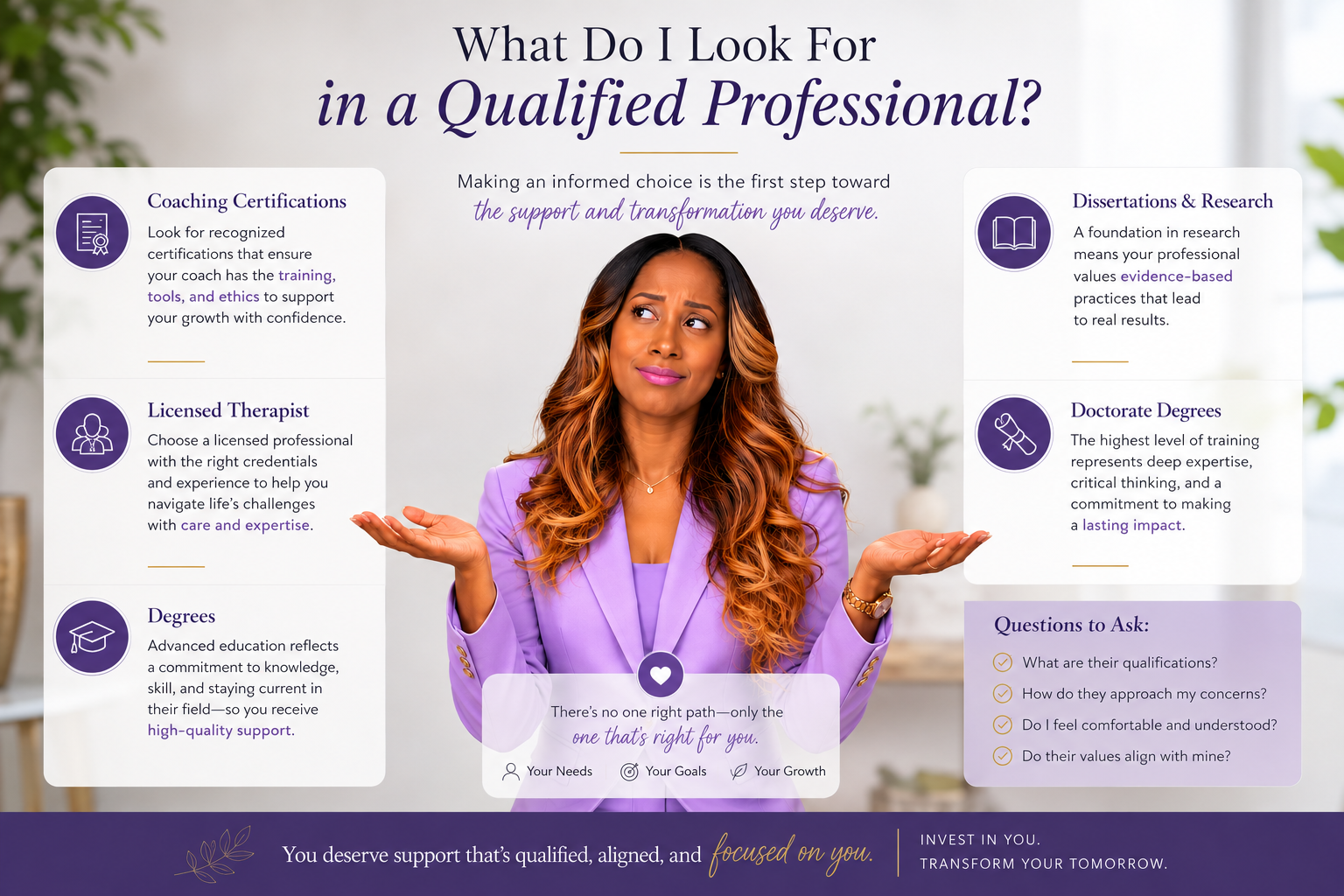
A conversation about coaches, credentials, licensure, and ethical transparency in the age of influence
There’s been a lot of conversation online lately surrounding credentials, titles, influence, and who is truly qualified to help people navigate emotional, relational, and psychological challenges. While much of the discourse has centered around public figures like “Dr.” Cheyenne Bryant, this conversation is bigger than any one person.
This is about clarity.
This is about ethics.
And most importantly, this is about protecting vulnerable people from confusion in an era where branding often moves faster than discernment.
As someone who works in the coaching space—and who is also pursuing formal social work education—I believe we need more honest conversations about the differences between advisors, mentors, coaches, licensed professionals, honorary doctorates, and earned doctoral degrees.
Not to shame people.
Not to gatekeep healing.
But to educate the public with accuracy and integrity.
The Internet Has a Credential Crisis
Social media has democratized information in incredible ways. People now have access to coaches, educators, therapists, influencers, and motivational speakers from around the world. That accessibility can be empowering—but it can also create confusion when titles are used without context.
A polished platform, compelling storytelling, and confidence can create the perception of authority very quickly. But authority and expertise are not always the same thing.
Research has consistently shown that ethical boundaries, competency standards, and scope-of-practice distinctions matter significantly in helping professions (Firmin et al., 2019).
And when people are grieving, divorcing, traumatized, anxious, or emotionally vulnerable, clarity becomes more than professionalism—it becomes compassion.
Advisor vs. Mentor vs. Coach: Not the Same Role
Advisor
An advisor provides guidance based on experience, knowledge, or expertise in a specific area. Advisors may offer insight on relationships, business, finances, leadership, or life transitions. Some have formal education. Some do not.
An advisor can absolutely be valuable.
But “advisor” is not automatically a regulated or clinically trained role.
Mentor
Mentorship is deeply relational. Mentors support growth through wisdom, lived experience, encouragement, and accountability.
Some of the most transformative people in our lives are mentors—not because they held degrees, but because they carried wisdom, consistency, and emotional maturity.
A mentor can change your life without ever holding a license.
Coach
This is where much of the public confusion exists.
Coaching is generally future-focused and goal-oriented. Coaches help clients improve performance, mindset, communication, accountability, and personal growth by identifying goals, overcoming obstacles, and creating actionable strategies for change. Unlike licensed mental health professions, the coaching industry is largely unregulated in the United States, meaning there is no universal legal standard governing who may call themselves a coach (Zur, 2025).
As a result, training and qualifications can vary considerably. Some coaches complete rigorous programs through established coaching organizations and professional associations, while others obtain short-term certifications or develop expertise through lived experience and specialized training.
Like many professions, coaching includes niche areas of practice. For example, Divorce Coaches help individuals navigate the emotional and logistical complexities of separation by strengthening communication skills, improving conflict management, supporting effective co-parenting, and helping clients make thoughtful decisions during a highly stressful life transition. Their role is to help clients move from emotional reactivity toward intentional action while developing a vision for life beyond divorce.
This variation in training and specialization does not make coaching ineffective. In fact, coaching can be profoundly transformative for individuals seeking support, accountability, and forward movement. However, it is important to understand that coaching is distinct from psychotherapy. Coaches do not diagnose mental health conditions or provide clinical treatment unless they separately hold professional licensure and are practicing within that scope.
This distinction matters both ethically and legally. As Jordan (2013) notes, coaching and psychotherapy share common elements related to facilitating growth and change, yet they differ significantly in their scope, purpose, and professional responsibilities. Understanding those differences helps consumers make informed decisions about the type of support that best meets their needs.
Honorary Doctorate vs. Earned Doctorate
This is another area where the public often gets confused.
Honorary Doctorate
An honorary doctorate is a ceremonial recognition awarded for contribution, philanthropy, influence, leadership, or achievement.
It is an honor.
It is not the same as completing doctoral coursework, dissertation research, clinical training, or board requirements.
That distinction is important.
There continues to be ethical debate surrounding public use of the “Dr.” title when the doctorate is honorary rather than academically earned. Transparency matters because the average person often assumes “Dr.” implies advanced academic or clinical training.
And when people are seeking emotional, psychological, or relational guidance, that assumption carries weight.
Earned Doctorate
An earned doctorate is not merely a label—it reflects participation in a rigorous academic process designed to develop specialized expertise and contribute new knowledge to a field (Holley, 2023).
It typically involves:
- Years of advanced academic study
- Research methodology
- Dissertation or capstone defense
- Clinical residency or supervised training (depending on field)
- Comprehensive examinations
Examples include:
- PhD
- PsyD
- EdD
- DSW
- MD
Doctoral-level education represents academic rigor and specialized expertise developed over years—not simply popularity or influence.
Why This Conversation Matters
At first glance, this may seem like a debate about titles.
It isn’t.
It’s a conversation about trust.
Most people seeking support are not scrolling social media because life is going perfectly. They are navigating divorce, trauma, grief, burnout, anxiety, parenting challenges, career transitions, or identity shifts. They are looking for answers, guidance, and hope.
When people are vulnerable, they often rely on visible signals to determine who they can trust. Degrees, licenses, certifications, and professional titles become shortcuts for credibility. That’s why clarity about credentials is not merely a marketing issue—it’s an ethical one.
Research consistently demonstrates that public trust is influenced by perceptions of competence, integrity, reliability, and accountability. Trust grows when people believe professionals are qualified to perform the role they claim to occupy and when systems communicate those qualifications transparently (Platt et al., 2017).
This is precisely why professional distinctions matter.
Levitt et al. (2015) argue that consistency, structure, and clear professional standards are necessary for the public to trust helping professionals and to feel confident that they are being served by qualified and competent individuals. When roles become blurred, titles become inflated, or credentials are presented without context, public confidence can erode—not only in one professional, but in an entire field.
Whether someone is a mentor, coach, licensed clinician, educator, or researcher, transparency protects both the professional and the public.
The goal is not hierarchy.
The goal is informed consent.
People deserve to know:
- Who is helping them.
- What training that person has completed.
- What services they are qualified to provide.
- Where the boundaries of their expertise begin and end.
Because trust is not built through impressive branding.
Trust is built through competence, integrity, and honesty.
And in helping professions, those qualities matter far more than any title preceding a person’s name.
My Personal Perspective: The Real Question Is Bigger Than One Person
As a Certified Divorce, Transition, and Recovery Coach® who is transitioning into the social work profession, I see a much bigger dynamic playing out than whether one public figure should or should not use a particular title.
At its core, this conversation reveals a growing tension between accessibility and accountability.
The reality is that millions of people need emotional support, guidance, education, and healing resources. Yet many face barriers to accessing traditional mental health services, including cost, insurance limitations, provider shortages, cultural mistrust, geographic location, scheduling constraints, and stigma.
In response, people are increasingly turning to coaches, online educators, podcasts, social media creators, support groups, faith communities, and digital wellness platforms.
This shift is not entirely negative.
In fact, Mullan (2023) argues that mental health professionals often work within systems that perpetuate colonial ideals and privilege Western approaches to helping, sometimes overlooking the cultural, spiritual, relational, and community-based ways people make meaning and seek healing. As technology continues to democratize information, individuals now have unprecedented opportunities to co-create wellness plans that align with their values, beliefs, culture, lived experiences, and financial realities.
For many people, healing may involve therapy.
For others, it may involve coaching.
For some, it may involve faith leaders, peer support groups, books, podcasts, or a combination of multiple resources.
I believe there is room for all of these pathways.
The question is not whether one helping profession should replace another.
The question is whether we are being transparent about what we offer, how we are trained, and where the limits of our expertise exist.
As someone who proudly identifies as a coach, I do not see coaching as inferior to therapy. Nor do I believe licensure automatically makes someone the best fit for every client. What I do believe is that ethical professionals—regardless of title—should clearly communicate their qualifications, scope of practice, and intended role in a person’s healing journey.
Because trust is built when people know exactly what they’re receiving.
Final Reflection: Beyond Titles
Perhaps the most important lesson from this moment is that people are looking for more than credentials.
They are looking for safety.
They are looking for understanding.
They are looking for someone who can help them make sense of their pain.
The public conversation surrounding titles, degrees, and credentials should encourage us to ask deeper questions:
- How do we make quality support more accessible?
- How do we honor multiple pathways to healing while maintaining ethical standards?
- How do we ensure that vulnerable people can make informed decisions about the help they receive?
- How do we balance innovation and accessibility with accountability and transparency?
These are not easy questions.
But they are important ones.
Because healing has never belonged exclusively to one profession, one discipline, or one credential.
At the same time, professional standards exist for a reason. They help protect the public and create trust in the helping relationship.
The challenge moving forward is not choosing between accessibility and accountability.
It is learning how to hold both.
So perhaps the question is not:
“Who deserves to use a title?”
Perhaps the better question is:
“How can we create a helping ecosystem where people have access to ethical, transparent, culturally responsive, and effective support—regardless of where they begin their healing journey?”
That is a conversation worth having.
References
Firmin, M. W., DeWitt, K., Zurlinden, T. E., Smith, L. A., & Shell, A. L. (2019). Differences in competency and qualification requirements between APA and ACA code of ethics. Journal of Integrated Social Sciences, 9(1), 39–56.
Gebhardt, J. A. (2016). Quagmires for clinical psychology and executive coaching: Ethical considerations and practice challenges. American Psychologist, 71(3), 216–235.
Holley, K. A. (2023). Perspectives on doctoral education in the United States: Challenges and paths forward. Innovations in Education & Teaching International, 60(5), 775–783. https://doiorg.arbor.idm.oclc.org/10.1080/14703297.2023.2237953
Jordan, M., & Livingstone, J. B. (2013). Coaching vs Psychotherapy in health and Wellness: Overlap, Dissimilarities, and the Potential for Collaboration. Global advances in health and medicine, 2(4), 20–27. https://doi.org/10.7453/gahmj.2013.036
Levitt, D., Farry, T., & Mazzarella, J. R. (2015). Counselor ethical reasoning: Decision making practice versus theory. Counseling and Values, 60, 84-89.
Mullan, J. (2023). Decolonizing therapy: Oppression, historical trauma, and politicizing your practice. W. W. Norton & Company. https://www.decolonizingtherapy.com/book
Platt, J., Jacobson, P. & Kardia, S. (2017). Public Trust in Health Information Sharing: A Measure of System Trust. Health services research. 53. 10.1111/1475-6773.12654.
Robiner, W. N., Arbisi, P., & Edwall, G. E. (1994). The basis of the doctoral degree for psychology licensure. Clinical Psychology Review, 14(2), 133–145.
Zur, O. (2025, January). The unregulated coaching industry. The National Psychologist. https://www.nationalpsychologist.com/coaching-ethics
Leave a Reply